Your client types an address. We draw the roof in 3D, place the panels, simulate the year in 15-minute sun steps, price it from your package and put the request in your inbox with the 3D roof, the system and an offer at your price. Homeowners who run the estimate on numsolar.com see your price card next to the others — and send you their request.
Free during the pilot · no card · Swedish starter kit with Skatteverket's grön teknik rules
Six things Numsolar does for an installer
Example
ES
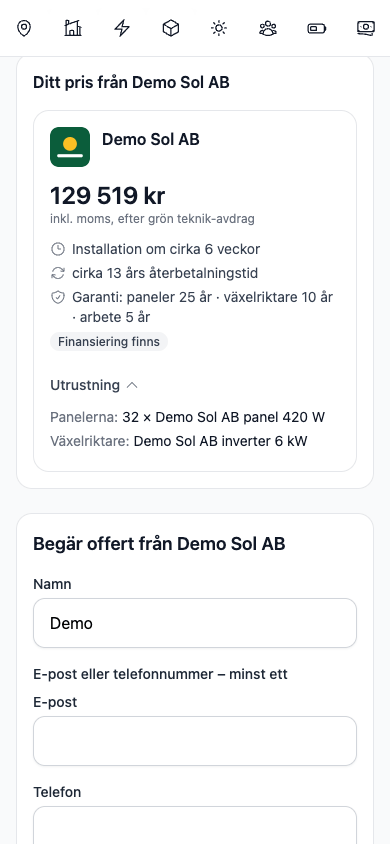
Example Solar AB
128 000 SEK
incl. VAT, after grön teknik
Installation in about 6 weeks
about 9 years payback
Warranty: panels 25 years · workmanship 10 years
Homeowners find you
Every homeowner who runs an estimate on numsolar.com sees a price card from every listed installer that serves the address, sorted by price. The homeowner picks up to three and sends the request. It lands in your inbox with the 3D roof, the system, the estimate, the contact and an offer at your price, ready to edit.
A client link with your logo, your prices and only your card; an embed on your own site; a public link for your ads. One 3D editor for the client's run and your offer: panels, obstacles, trees, wiring, margins.
Loads from Boverket's EKS 11 maps at the house, the zones drawn on each face, the values on the offer and in the package rules. An estimate for the quote that you confirm.
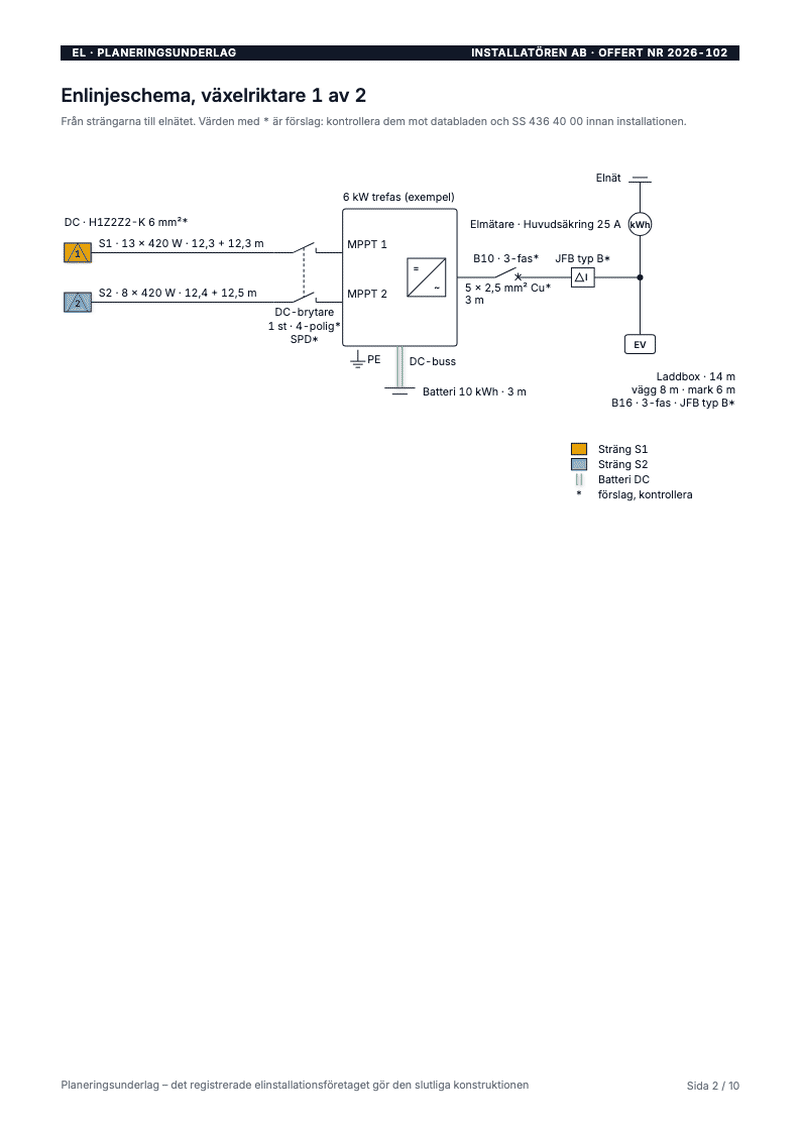
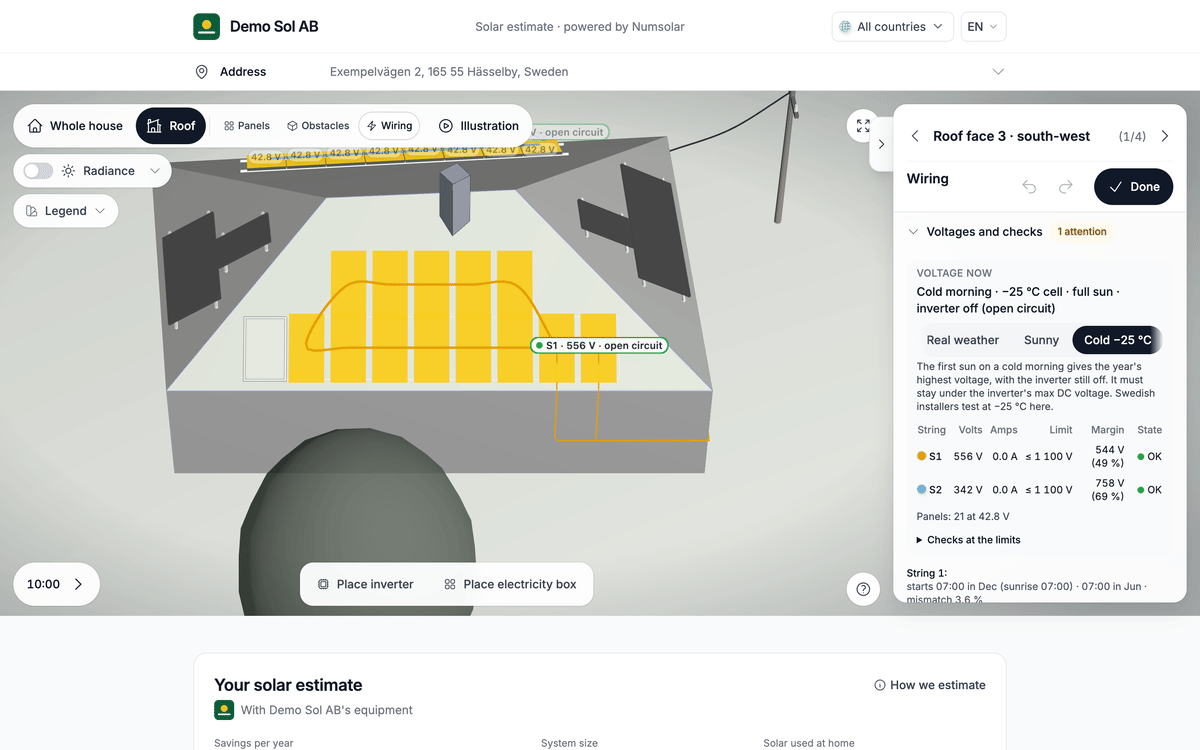
Strings per inverter input, cables routed round chimneys and skylights, string voltage at −25 °C and 70 °C, a single-line diagram and a stringing report PDF for the electrician.
Sol prepares the offer for a lead you assign: roof, layout, simulation, price from your packages, PDF, a draft email. Admin keeps your prices, packages and permissions in order. Nothing is sent and no price changes without your approval.
An open API for yield and simulation with OpenAPI docs, HubSpot contacts and deals, Fortnox invoices with the grön teknik work types, Formify e-signed agreements, and 29 free PDF templates with your brand.
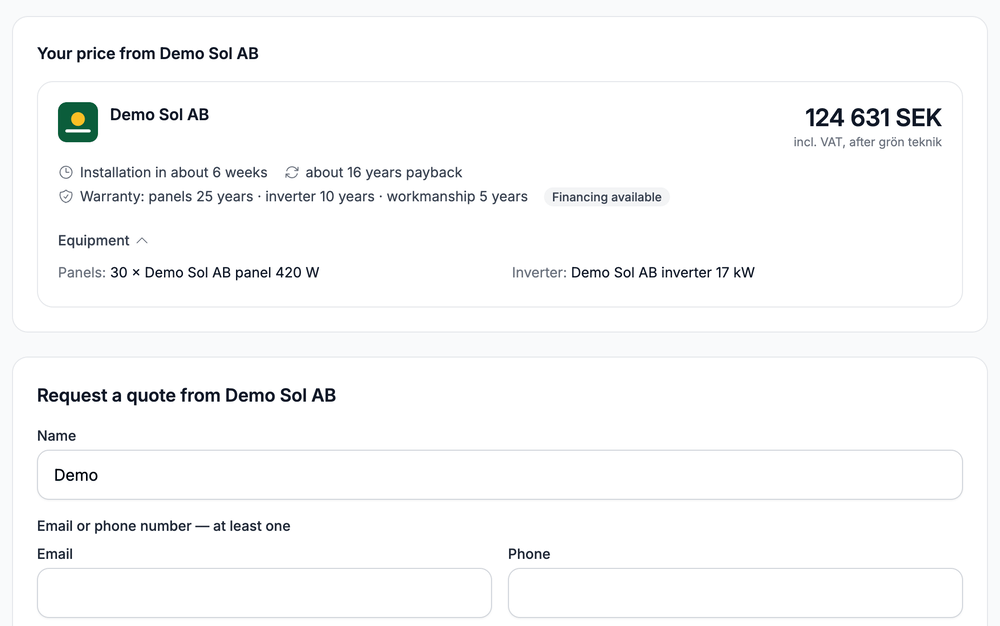
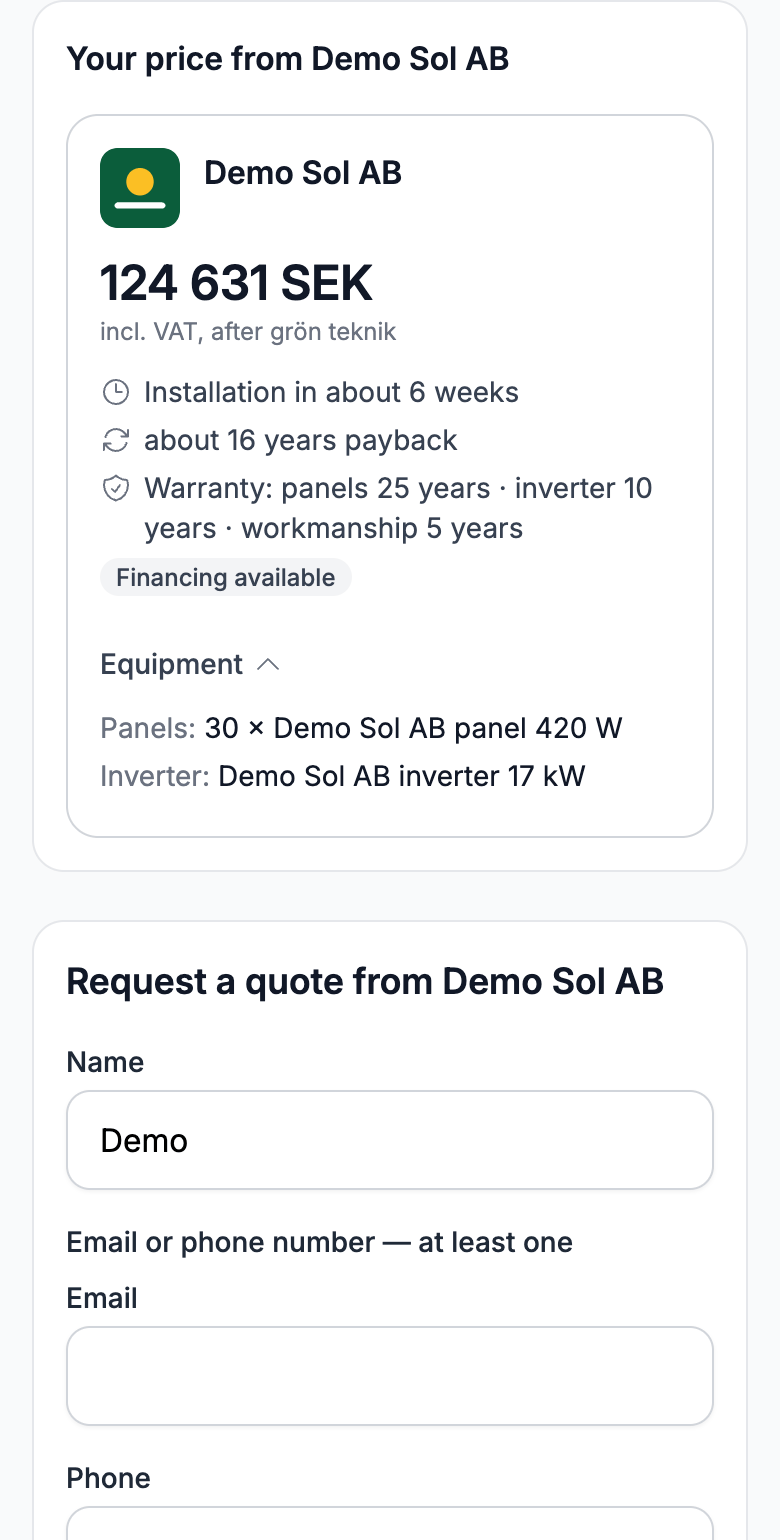
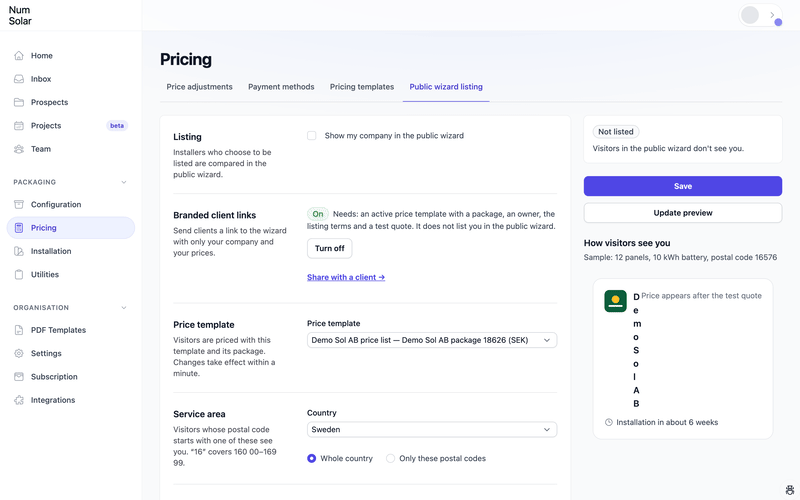
You list one package and one price template, plus the area you serve (a country and, if you want, postal-code prefixes). From then on every estimate in your area is priced through your package in about half a millisecond, and your card shows next to the others for the homeowner's own roof, sorted by price. Nobody pays for placement; you choose what the card shows: waiting time, warranties, financing, equipment.
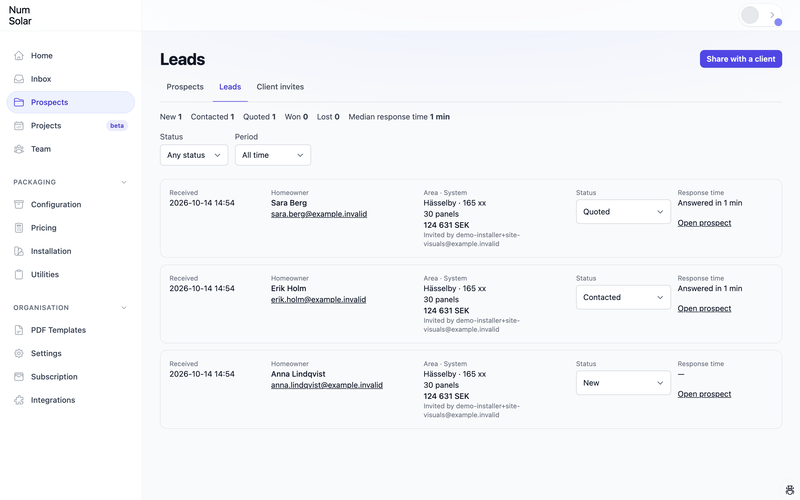
A request is a lead with everything the homeowner saw: the 3D roof with the panels, obstacles and trees they adjusted, the system, the estimate, the snow and wind loads, and an offer at exactly your card's price. It arrives as an email to the users you choose and in the lead inbox, where you set its status — new, contacted, quoted, won, lost — and see your response time. A weekly digest on Monday sums it up.
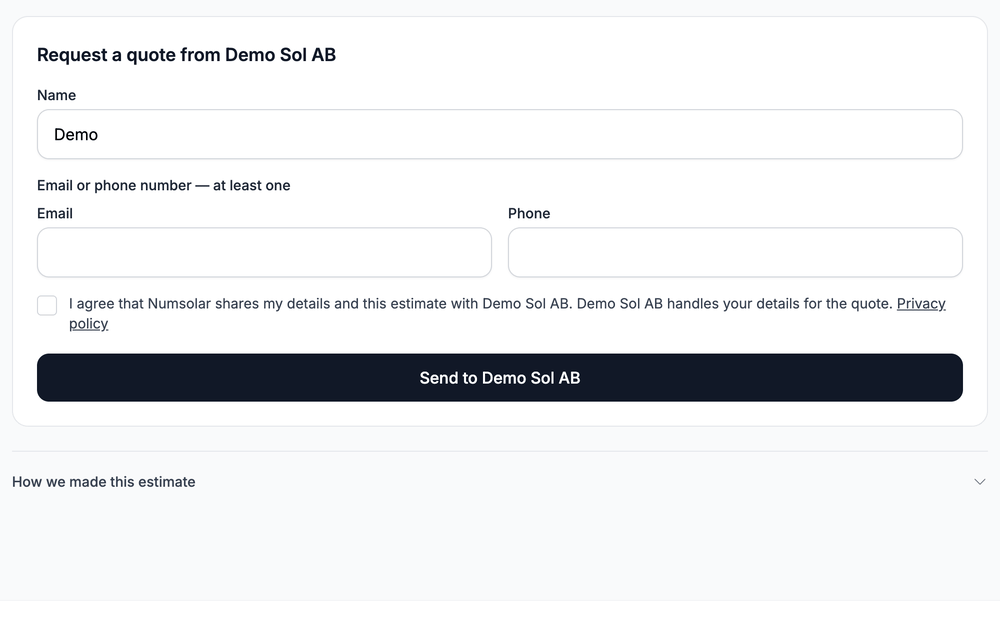
The homeowner ticks each installer separately and sees our privacy policy before sending. Their contact details reach only the installers they ticked; your listing shows only public company facts.
Example. How your card looks on the homeowner's page.
Example
The configurator, step by step
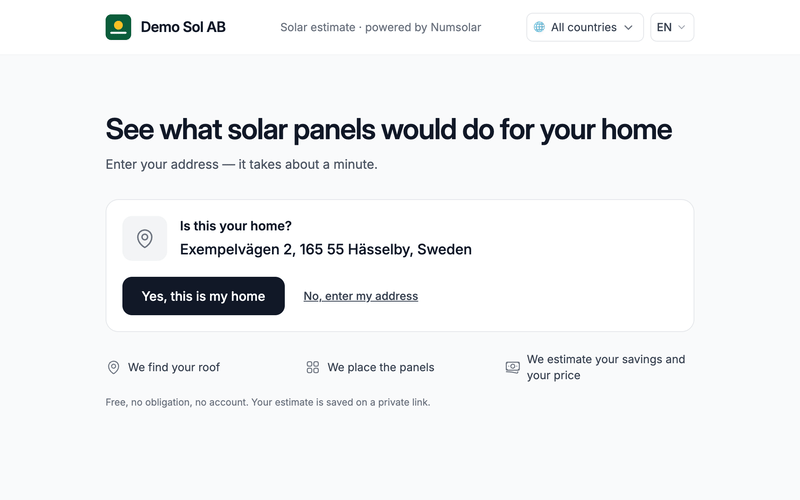
Send your client a link. They see only you, your price and their own roof.
1
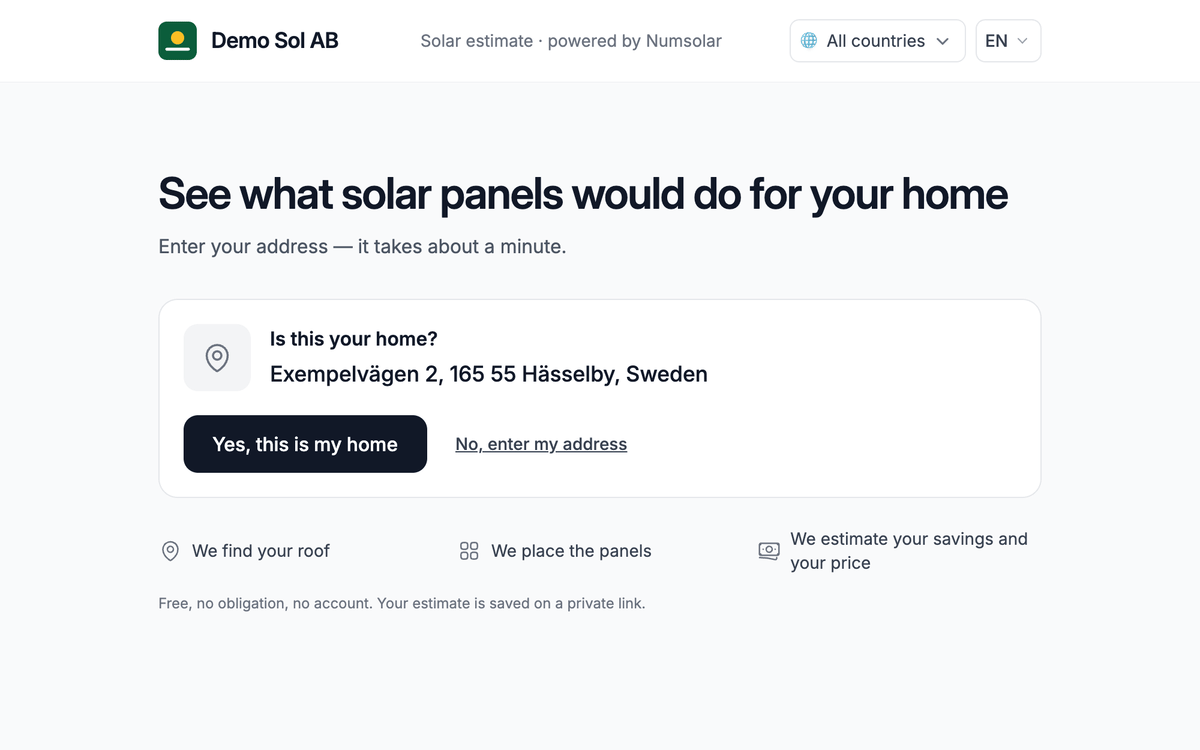
The address
Your client opens your link and types their address. We find the house on the map with Google.
2
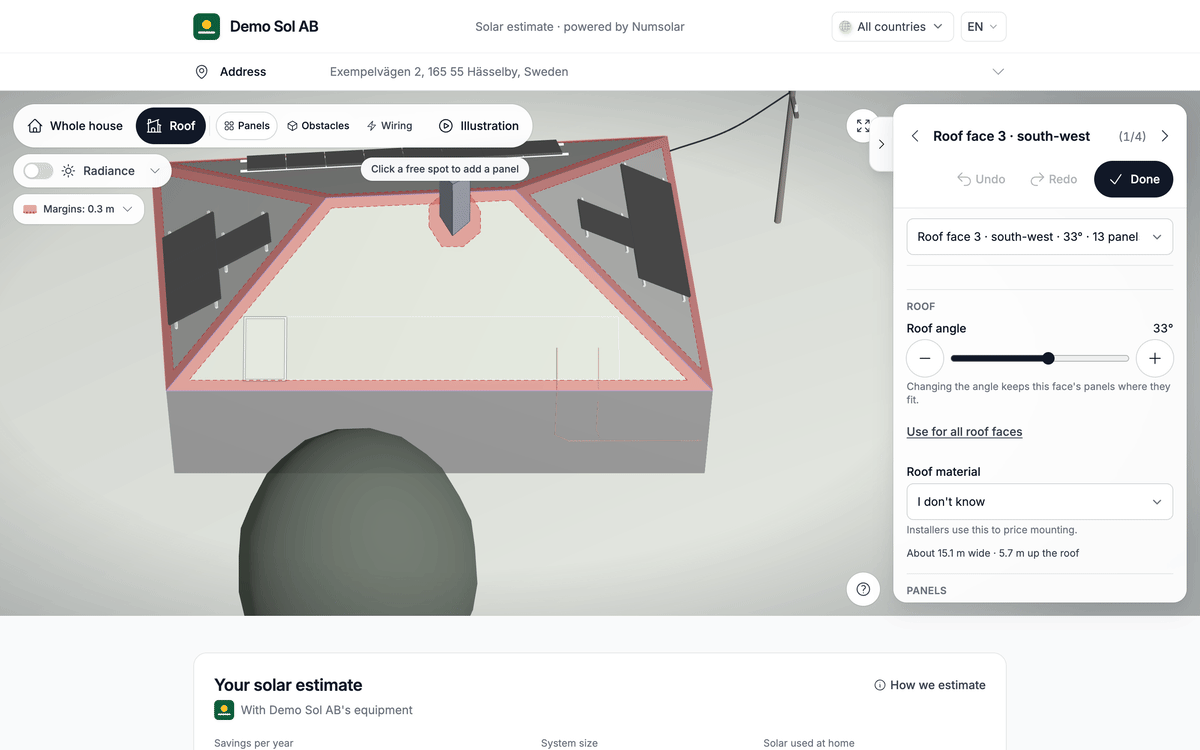
The roof, drawn by AI
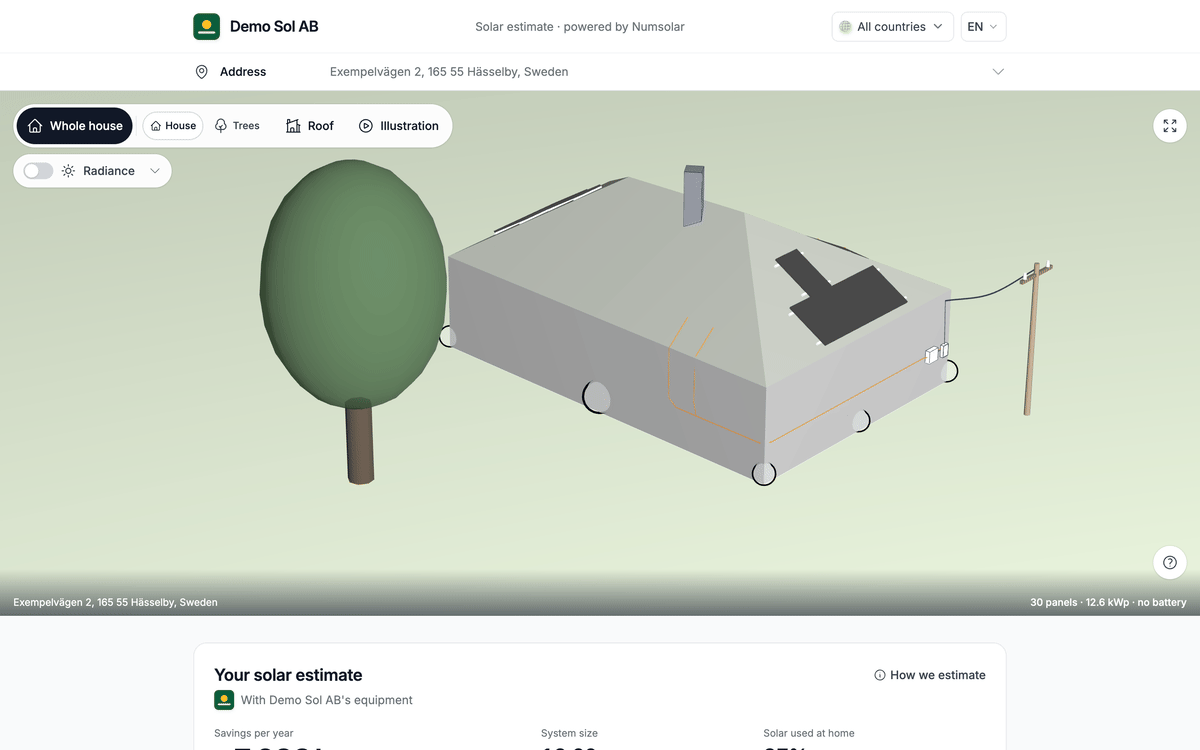
An AI model finds the roof faces on Google's aerial photo. We rebuild them in 3D and look for chimneys, skylights and trees nearby. The picture shows the test house on a plain ground, not the aerial photo.
3
Roof faces and panels
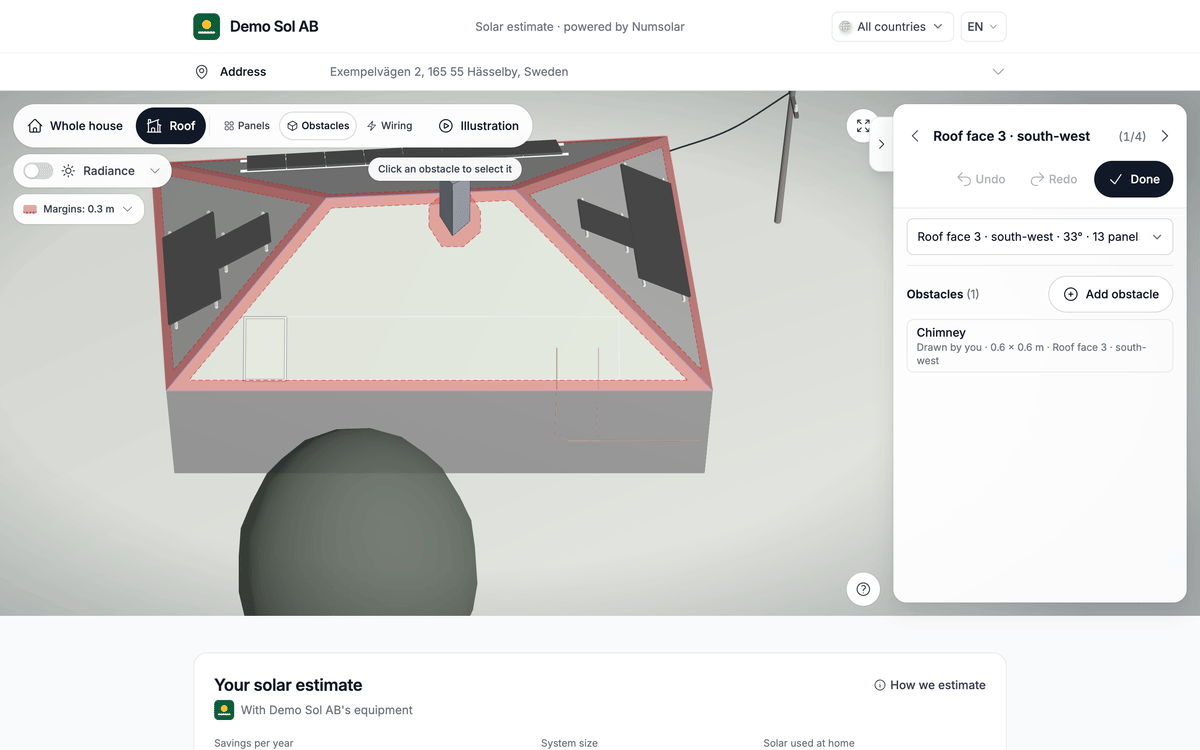
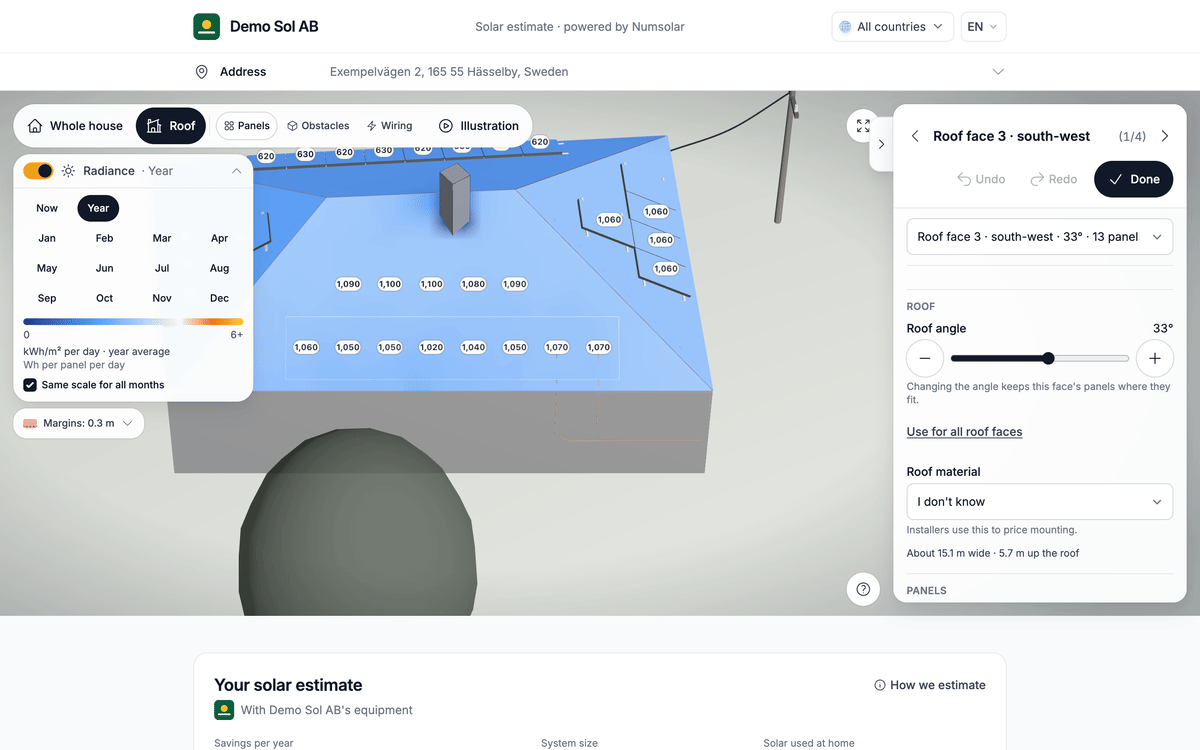
Each roof face gets its tilt, direction and size; your client can change the tilt or the roof material. The panels go on the faces that point south, east or south-west, with a margin from every edge and roof object.
4
Snow and wind
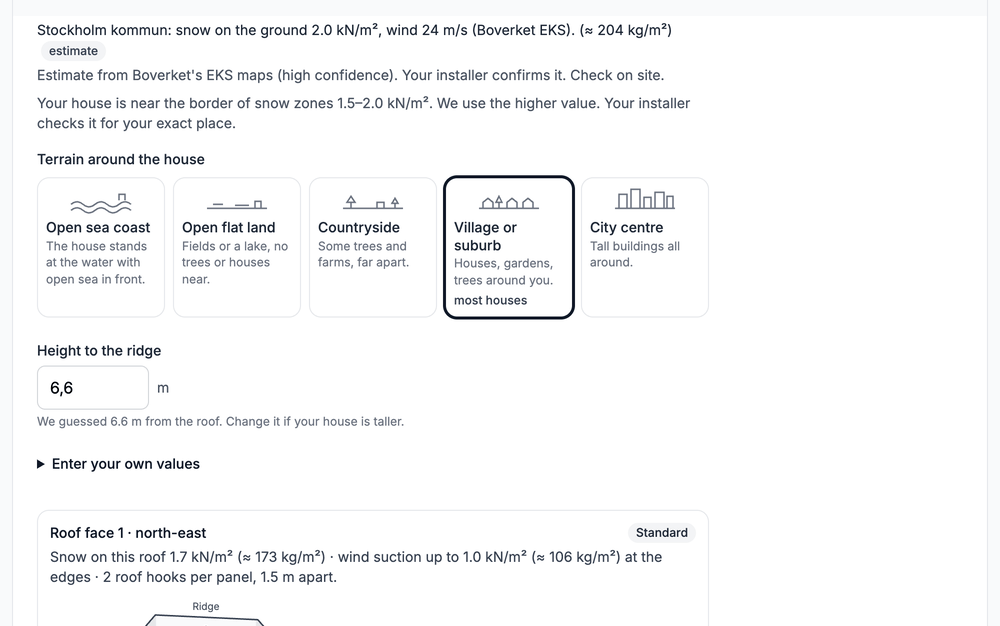
Snow and wind loads come from Boverket's EKS maps for the house's location. It is an estimate; you confirm it.
5
Shade from roof objects and trees
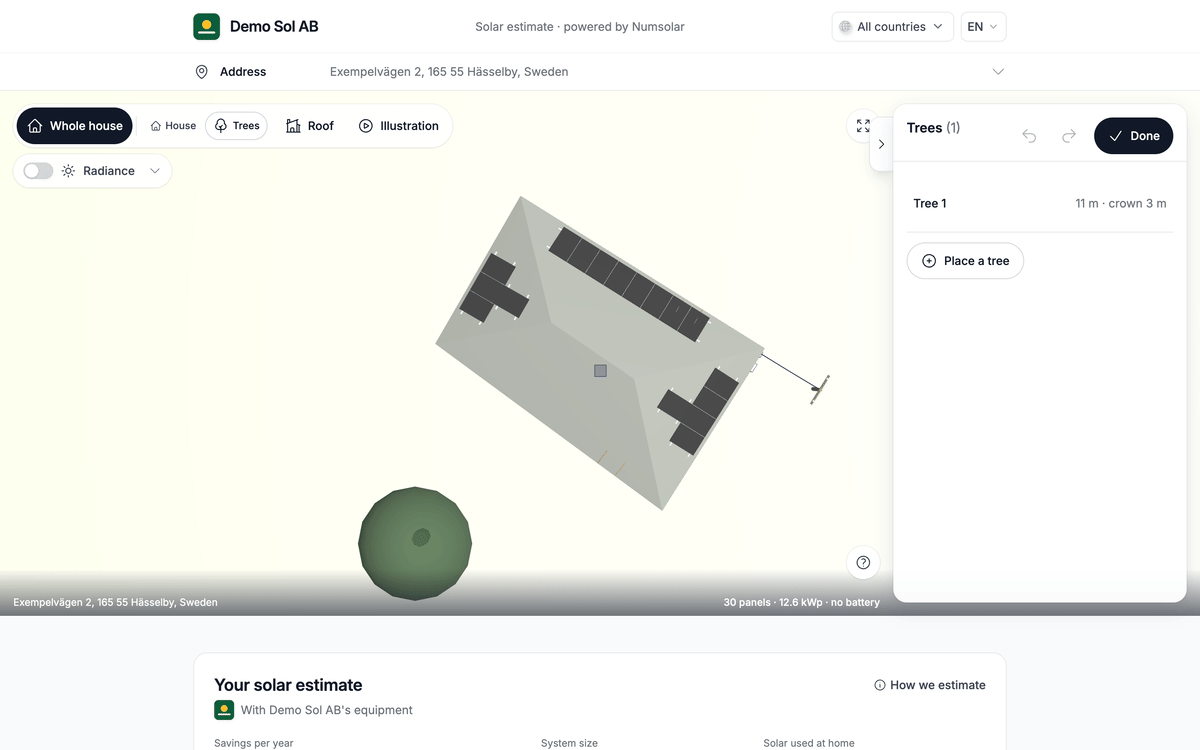
We follow the sun through the day and check what shades each panel: roof objects, trees and the house itself.
Chimneys, vents and skylights are solid blocks with a height (a chimney 1.2 m unless you change it). The panels keep a margin around them.
Each tree near the house gets an estimated height and crown; your client can move, add or resize them. A crown lets 15% of the light through, all year.
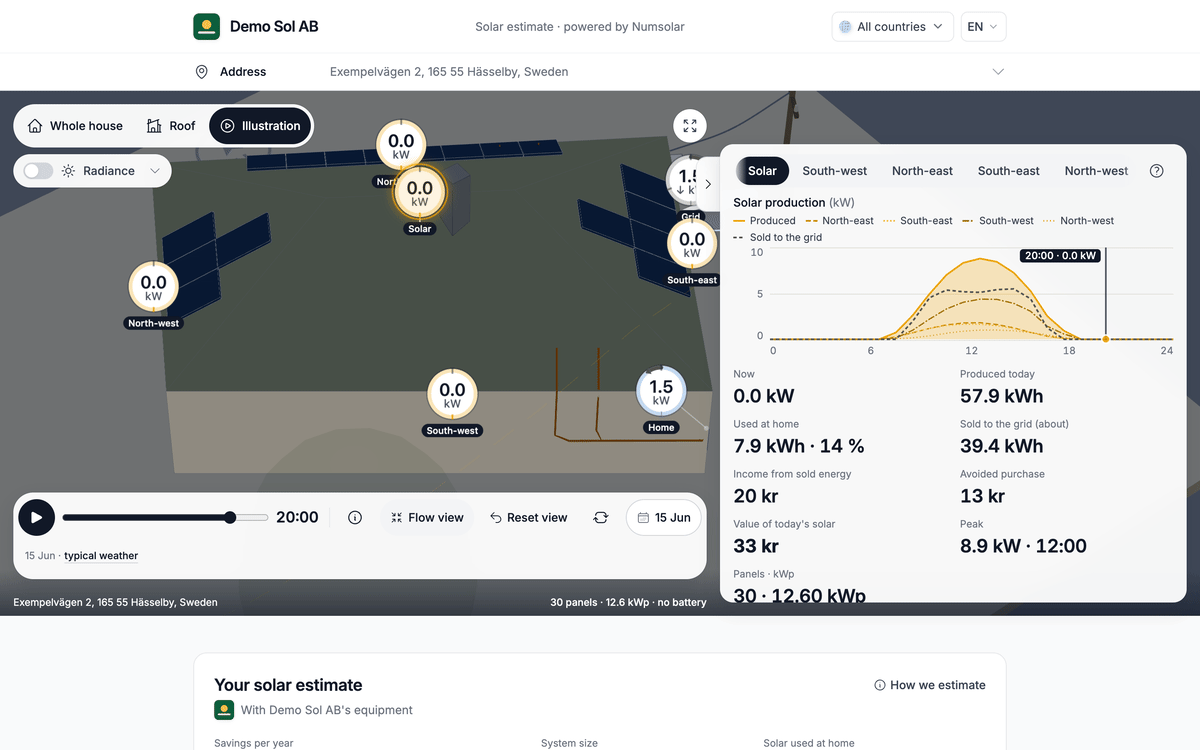
Radiance colours the roof by the sunlight it gets, per month or for the year, and shows what each panel produces per day.
6
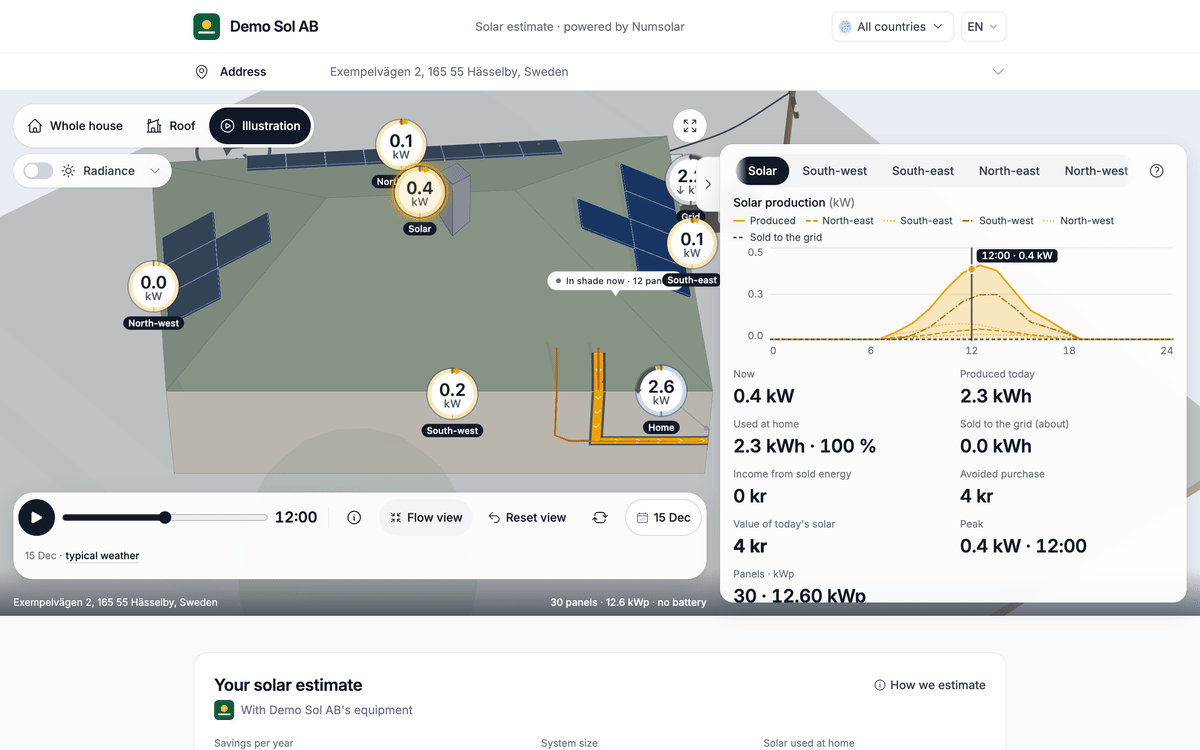
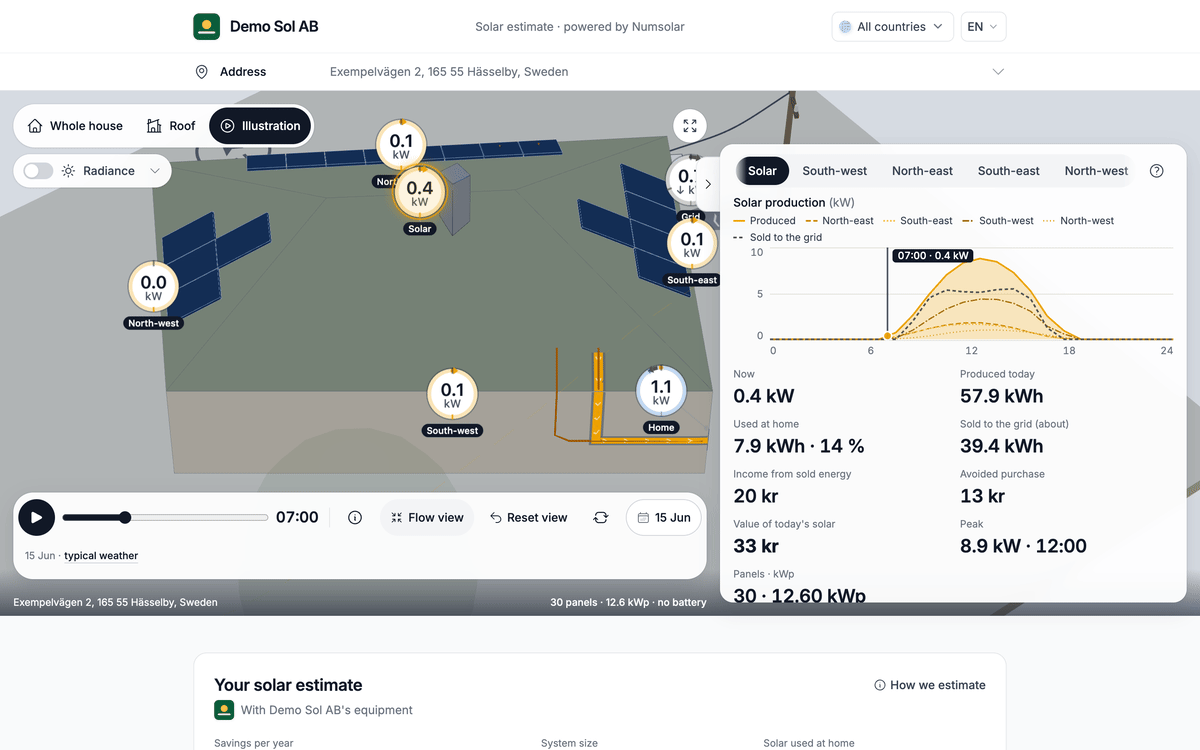
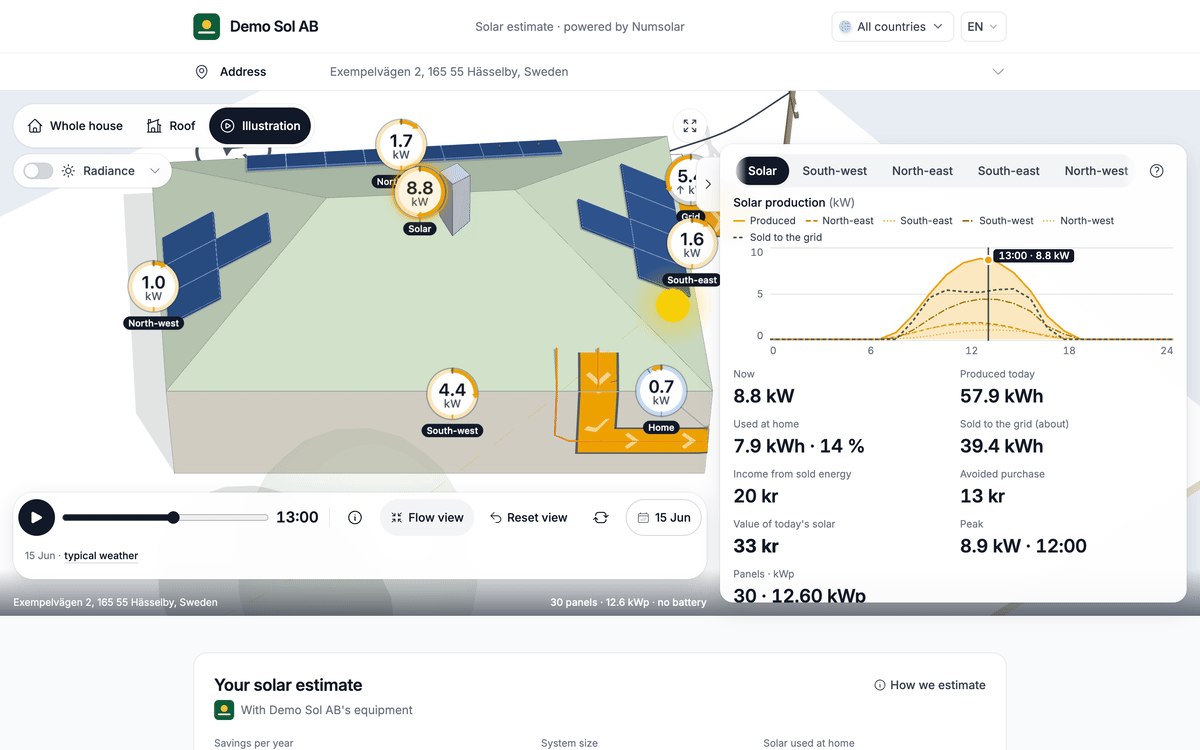
The sun every 15 minutes, the energy every hour
The sun's path, the shade and the sunlight on each panel are computed every 15 minutes of one typical day per month, 12 × 96 steps; in Sweden the sunlight comes from PVGIS data for the area. The home, battery, car and prices then run hour by hour, all 8 760 hours of the year.
7
Electrical wiring
We connect the panels in strings to the inverter's inputs and route the cable round roof objects. Each string's voltage is checked at −25 °C (colder further north) and with the panels at 70 °C. The electrician gets a stringing report as a PDF.
8
The savings, in kronor
Each hour gets its price: the average spot price for that hour and month in the client's price area over the last year, plus markup, grid fee, energy tax and VAT. Solar used at home saves that price, solar sold earns the spot price; a battery and an electric car are simulated the same way.
Example
9
A battery, four ways
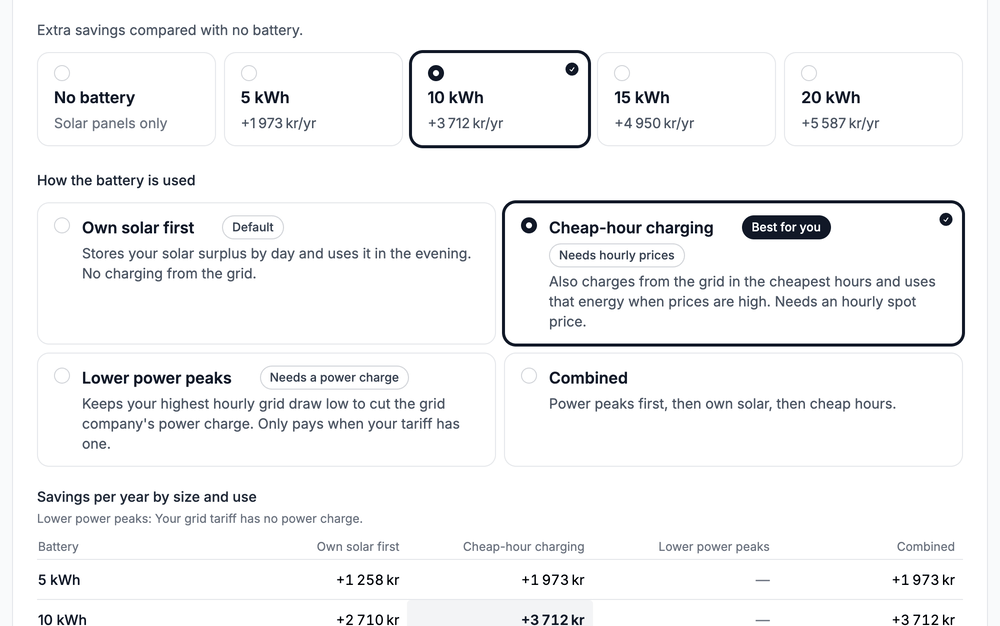
Four ways to use it: “Own solar first”, “Cheap-hour charging”, “Lower power peaks” (for a tariff with a power charge) and “Combined”. We pick the one that saves the most at your client's prices. Every battery loses 10% per round trip and keeps a 10% reserve.
Example
10
An electric car, five ways to charge
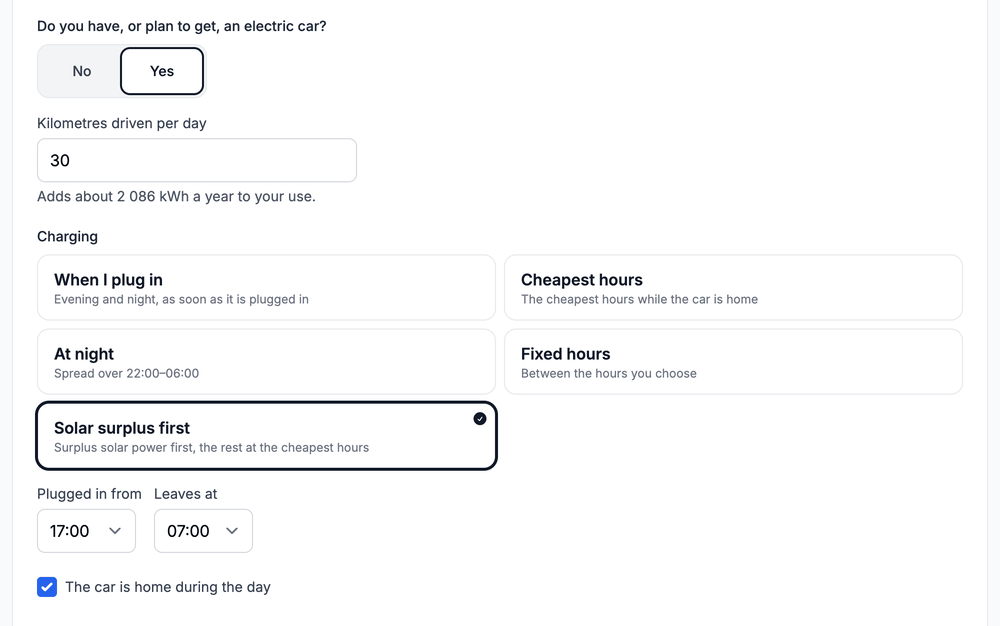
Five ways: “When I plug in” (evening and night), “Cheapest hours” while the car is home, “At night” (22:00–06:00), “Fixed hours” the client sets, and “Solar surplus first”, then the cheapest hours. A table compares the cost per year of all five.
Example
11
How much solar you use yourself
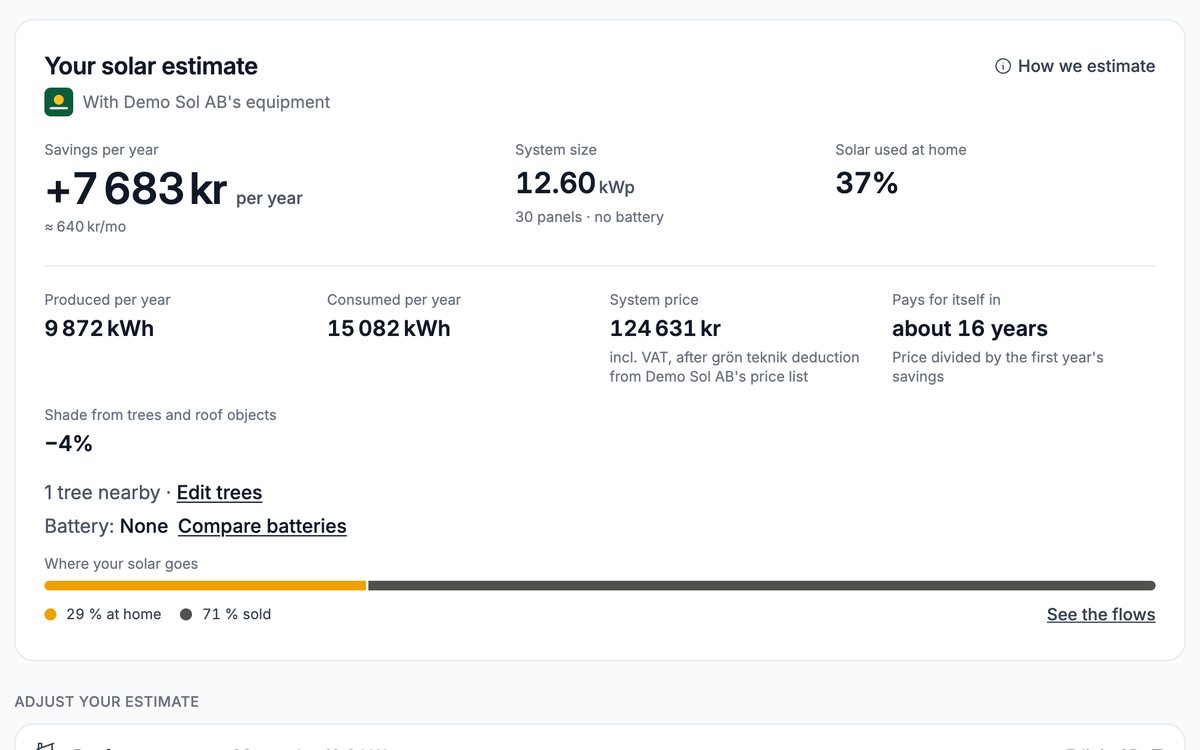
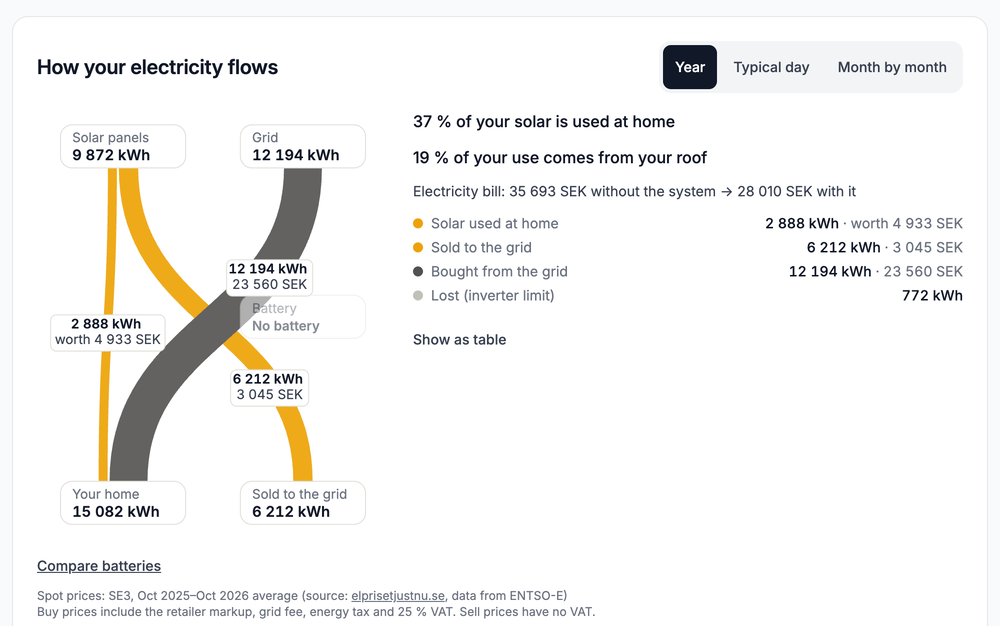
Self-use: the share of the solar you do not sell. Self-sufficiency: the share of your use that comes from the roof, directly or via the battery. A battery and a car that charges on solar raise both.
Example: 37% of the solar is used at home; 19% of the use comes from the roof.
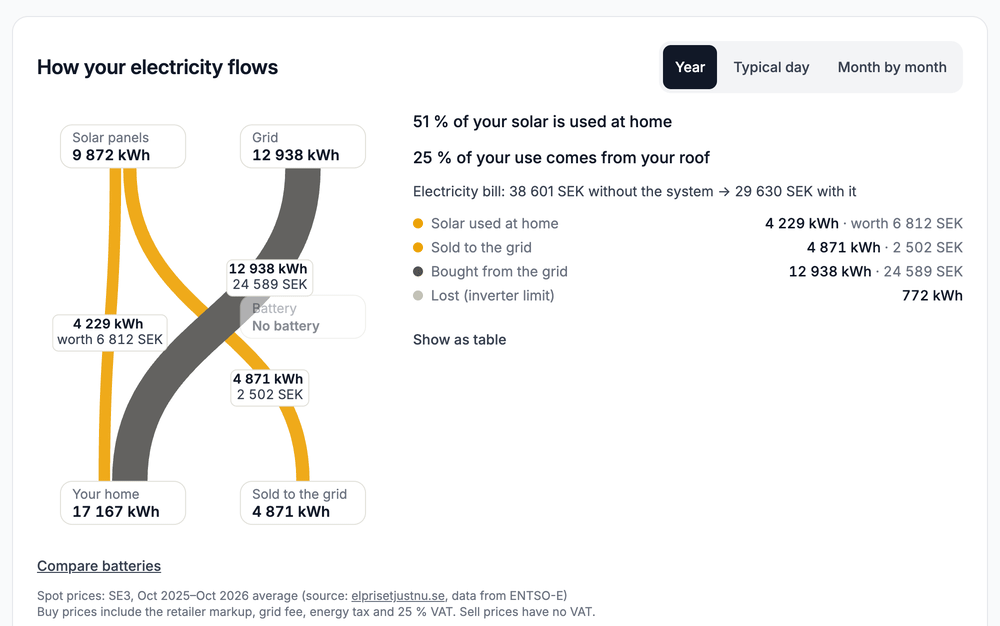
Example: the car charges on solar surplus while it is home: 51% of the solar is used at home.
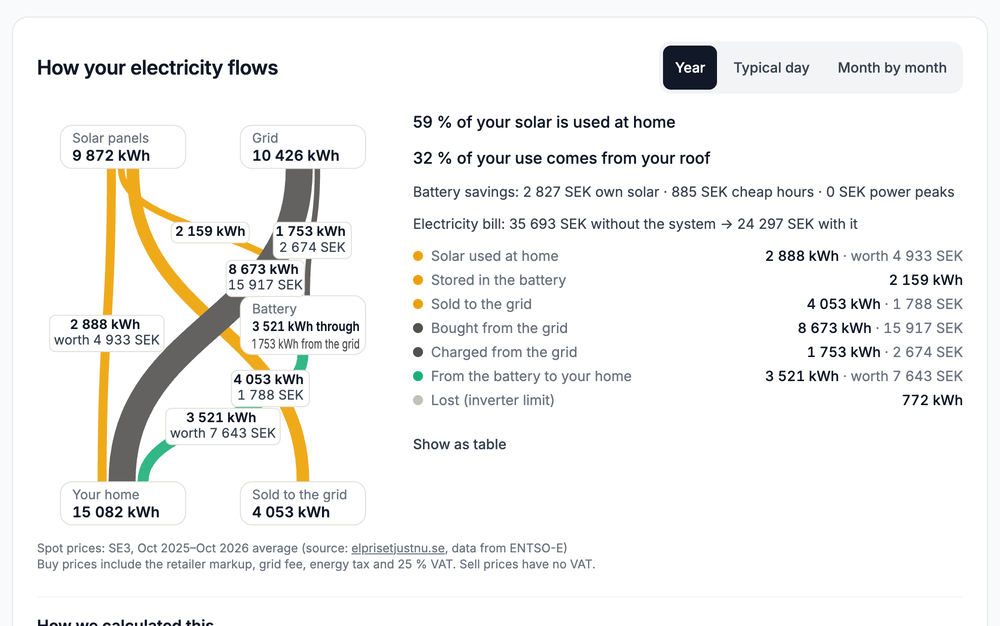
Example: 59% of the solar is used at home; 32% of the use comes from the roof.
12
Your price, after the deduction
The price comes from your own price list, VAT included, after the grön teknik deduction; payback is the price divided by the first year's savings. Our Swedish starter kit follows Skatteverket: 15% for solar and 50% for a battery or an EV charger, of 97% of a fixed price, at most 50 000 kr per person and year.
13
The request, in your inbox
Your client leaves a name and an email or phone number. You get an email, and the client, the 3D roof and an offer at the same price arrive in your Numsolar account.
/i/<token>: your name and logo, your price only, the request goes to you. Ten a month on the free listing.
Embed
The same configurator inside your own site, with your packages.
The same page, inside your site.
Public link
/i/<your slug> for ads and your website: anyone who opens it runs a branded estimate.
Snow and wind, per roof face
Snow and wind loads come from Boverket's EKS 11 zone maps, looked up at the house's coordinates; near a zone border we take the higher value and say so. Terrain category, building height, safety class and snow guards are inputs you or the client can change. Each roof face gets a zone diagram with the governing zone for every wind direction. The values go on the offer, into the package rules (mounting per zone) and to the project page; the client sees them on the estimate. An estimate for the quote, not a structural calculation: you confirm it. Sweden only.
Try your address on the map →
The snow load (s_k) and the wind speed (v_b) of each place in Sweden, on one map. Hover or tap the map, or try a place.
Loading the map…
Snow s_k (kN/m²)
5.5
4.5
3.5
3.0
2.5
2.0
1.5
1.0
Wind v_b (m/s)
26
25
24
23
22
21
Hatched: the zone border is less certain
Hover or tap the map to see the values of a place.
Examples
Malmö: snow 1.0 kN/m² (≈ 102 kg/m²), wind 26 m/s
Göteborg: snow 1.5 kN/m² (≈ 153 kg/m²), wind 25 m/s
Stockholm: snow 2.0 kN/m² (≈ 204 kg/m²), wind 24 m/s
Östersund: snow 2.5 kN/m² (≈ 255 kg/m²), wind 23 m/s
Kiruna: snow 3.0 kN/m² (≈ 306 kg/m²), wind 22 m/s
What it means for your quotes
Each roof face gets its snow and wind load per roof zone. Your packages get the panels per load range. So your quote picks the right mounting automatically.
· The load per roof zone: edge, corner and middle of each face.
· The values show on the offer and on the project page.
Based on Boverket's EKS 11 maps (BFS 2019:1). These are estimates: the installer confirms on site. Hatched areas are less certain.
Län borders: Natural Earth.
The plan is made from the same roof as the estimate. Strings are grouped by shade so one shaded panel does not pull down a whole string, cables are routed round chimneys and skylights and the series order is the one with the least cable. The design temperatures follow the latitude: −25 °C south of 60° N, −30 °C to 64° N, −35 °C above; the hot check is at 70 °C, flush mount. The stringing report lists each string's panels, Voc and Isc at both temperatures, cable lengths and the inverter's limits.
Give us your website address: we read its colours, fonts, corner radius and logo (no AI, at most 10 requests) and propose a brand scheme. Edit it, keep up to 20 schemes, and every template in the gallery renders in yours. Four sample houses show every page before you pick one.
Your certifications on the offer
Coming
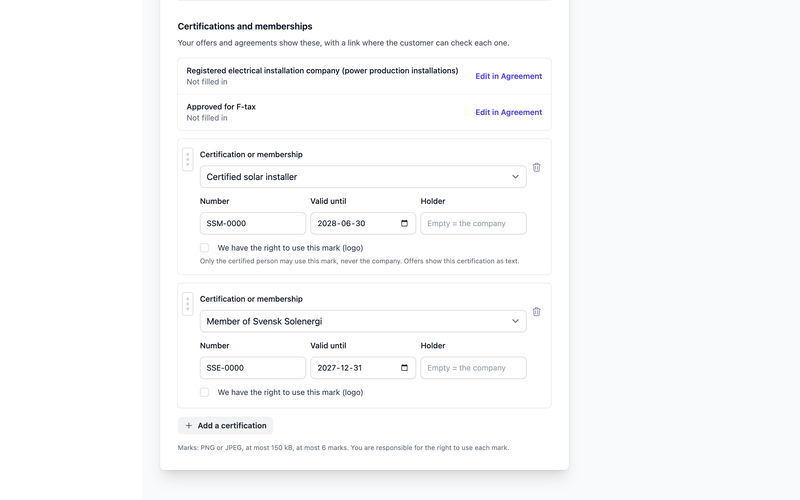
Add your Elsäkerhetsverket registration, F-tax, Svensk Solenergi, Installatörsföretagen with IN Garanti, ID06, ISO 9001/14001 or a certified installer (person) in the organisation settings, with the number and the expiry date. Where the issuer allows the mark, upload it; the templates print the list and the marks.
Two colleagues in your organisation who work from your own packages, price lists and templates. Nothing leaves your organisation and no price changes without a person's approval.
Coming
Sol (AI): sales and engineering
Coming
Assign a lead to Sol in your prospect list. Sol finds the roof, places the panels, simulates the year, prices the system from your packages, makes the PDF in your template and drafts the email to the homeowner. Every step is on the prospect's timeline; the price and the email wait for your approval. Sol's engineering notes list what to check on site: shade, the main fuse, föranmälan to the grid company, where the battery and the inverter go. Every email Sol drafts says that an AI helped prepare it and names the person who checked it.
Coming
Or write Sol a line — “Huawei package, 10 kWh battery, offer due Friday” — and Sol builds that offer.
Coming
Admin (AI): the catalogue in order
Coming
Ask Admin to raise a price across packages, add a package, change a team member's permissions or find stale prospects and missing data. Every change comes back as a diff — “Package X: 89 900 kr → 92 500 kr” — that an owner approves, as one undoable batch. Admin cannot touch billing, delete data or change its own permissions.
GET /api/v1/pv-yield answers kWh/kWp per year and month for any point in Sweden × tilt × azimuth; POST /api/v1/simulation/battery-strategies runs a year of hourly flows for your own PV and use series with up to 25 battery × strategy cells. No key: 60 yield lookups and 10 simulations per minute per IP; a key raises both tenfold. OpenAPI 3.1, CORS open, yield answers cached for a day with an ETag.
Solar yield
Stockholm · 35° · 180° · 9.24 kWp
983 kWh/kWp · 9,085 kWh/year
GET /api/v1/pv-yield?lat=59.33&lng=18.07&tilt=35&azimuth=180&kwp=9.24
Battery and strategies
15,000 kWh/year · Battery sizes: 0 / 5 / 10 kWh
10 kWh · Own solar first — charge with surplus, use in the evening · SEK 2,600/year
Yearly savings from the battery compared with no battery, at SE3 spot prices. The numbers come from the API response.
POST /api/v1/simulation/battery-strategies
Solar yield per month (kWh)
Own solar first — charge with surplus, use in the evening
Buy cheap at night, use when power is expensive
Shave power peaks — a lower power charge
Combined — peaks first, then own solar, then arbitrage
Prices: Nord Pool day-ahead averages per month and hour over the last 365 days, plus grid fee, tax and VAT.
Contacts and deals are created and updated from Numsolar; the calculation data arrives as numsolar_ properties on the deal.
Fortnox
The offer becomes an invoice with the right house-work type per line: SOLARCELLS, STORAGESELFPRODUCEDELECTRICITY or CHARGINGSTATIONELECTRICVEHICLE, and the tax-reduction amounts split per adult.
Formify
The agreement goes out for e-signature from the offer; the signed document comes back to the offer.
Your website
The configurator as an embed, the SDK documented at /docs/sdk, and the public link for ads.
An open API with no key. All simulation runs on our own servers.
Example
The Swedish starter kit calculates grön teknik with Skatteverket's current rules (rule set version 3, 11 October 2026): 15 % for solar panels, 50 % for a battery or an EV charger, of 97 % of a fixed price, at most 50 000 kr per person and year.
How to get started
1
Claim your listing (5 minutes)
Confirm your company with your work email. No card, no contract.
2
Add your prices
We give you a Swedish starter package to adjust: panels, inverter, battery, labour, VAT and grön teknik.
3
Get requests
Homeowners near you send their request with the roof, the system and the estimate — straight to your email and to Numsolar.
The free listing during the pilot: one seat, your packages and price lists, the lead inbox, ten client links a month and unlimited requests. PDF documents and more seats are part of the subscription. We tell you well in advance before anything changes.
Sign up your company
Your company and your work email — we email you a link, no password. Free, no card.
Questions
Does it cost anything?
No. The listing and the requests are free during the pilot.
Are we compared on price?
Cards are sorted by price for the homeowner's own system. Nobody pays for placement, and you choose what your card shows.
How do requests reach us?
By email the moment a homeowner sends one, as a lead in the inbox with the roof, the system and your price, and on Monday in the weekly digest.
Can we use our own 3D editor and PDFs?
The 3D editor in the offer is the same as the client's: panels, obstacles, trees, wiring, margins, with versions. Every PDF comes from a template in the gallery or one you upload, in your brand scheme.
What about GDPR?
Homeowners choose which installers get their request and their contact details. Your company's listing shows only public company facts.
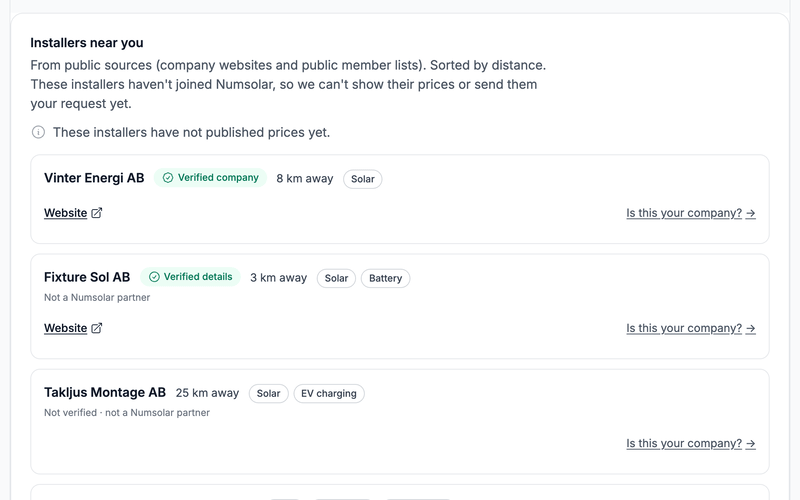
We don't want to be in the list
Tell us and we'll remove your company within 5 working days.